The songs
Cowboy Songs: 20 Classics and Their Stories
The cowboy songs worth knowing: 20 classic cowboy and Western songs, from old trail songs to the singing cowboys, with who wrote each one and when.
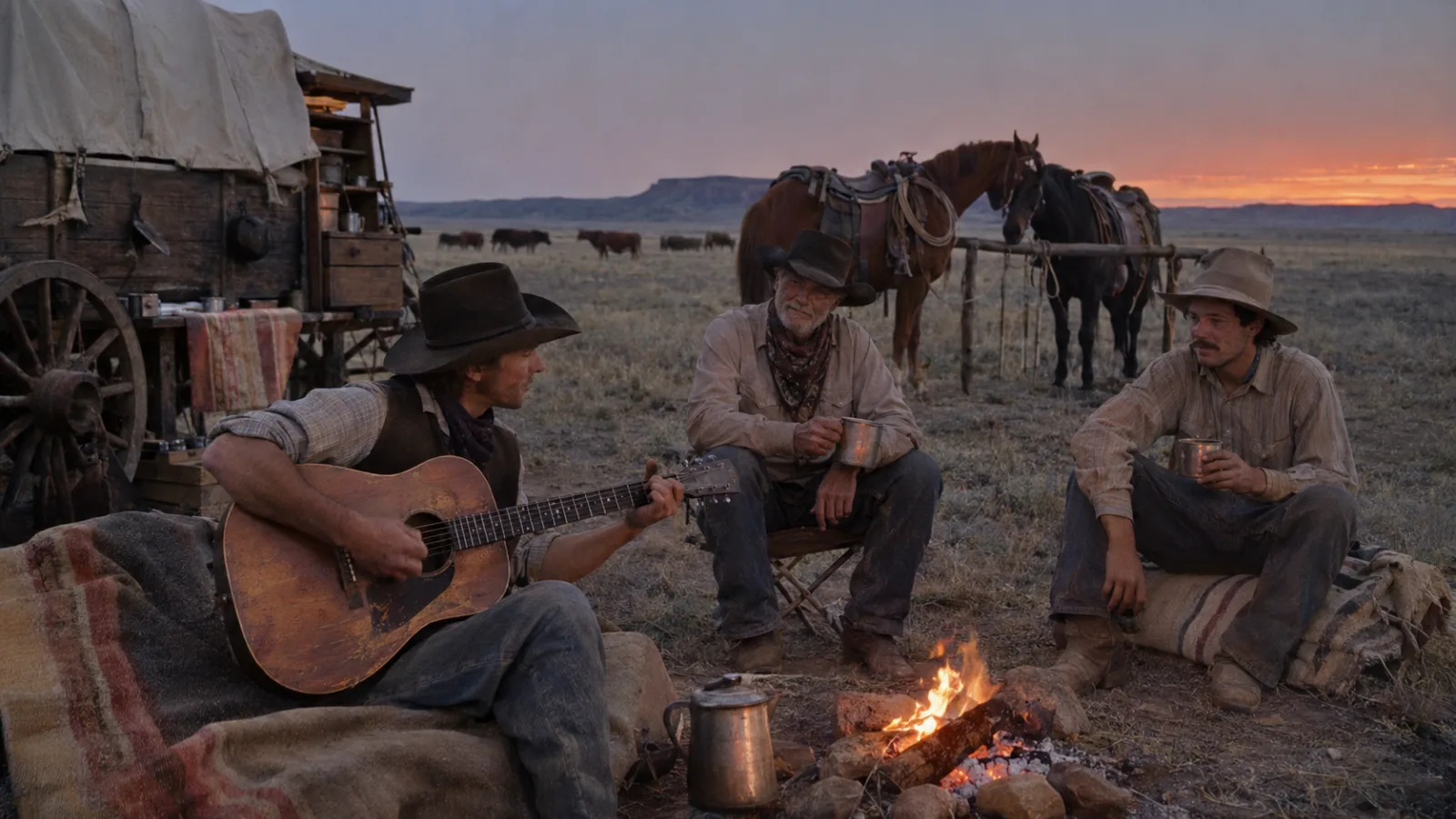
Cowboy songs are the songs working cowboys sang on the trail and in the bunkhouse, plus the Western songs written later about that life. The oldest date to the cattle drives of the 1870s and 1880s. The best known were written for records, radio and the movies between the 1930s and 1959.
If you are new to cowboy music, twenty songs will get you most of the way. Ten came off the trail and ten came from the singing cowboys. Here is each one, who wrote it, and why it lasted.
What makes a cowboy song?
A cowboy song tells a story about the work, the animals, the land or the people of the cattle country. The melody is simple enough to sing without a band, because the first singers had no band. Many old cowboy songs were sung at night to keep a herd quiet, and many were borrowed. A cowboy would take an older tune from Ireland, England or a hymnbook and fit new words to it.
That is the main difference from country music, which grew up in the Southeast with different subjects and a different sound. We cover that split in what Western music is and how it differs from country. The spoken side of the same tradition is in our guide to cowboy poetry.
Old cowboy songs from the trail
These ten are the core of any old cowboy songs list. Most have no single author. Two books saved them: Jack Thorp's Songs of the Cowboys (1908), which you can read free in its 1921 edition, and John Lomax's Cowboy Songs and Other Frontier Ballads (1910).
| Song | Origin | What to know |
|---|---|---|
| "The Old Chisholm Trail" | Traditional | A trail driver's string of complaints, with as many verses as the singer could invent. Printed by Lomax in 1910. |
| "Git Along, Little Dogies" | Traditional | Owen Wister wrote it down in his journal in 1893. A dogie is an orphaned or runty calf. |
| "The Streets of Laredo" | Traditional | Also called "The Cowboy's Lament." A dying cowboy tells his story. It comes from an Irish ballad, "The Unfortunate Rake." |
| "Home on the Range" | Brewster Higley, 1872 | Began as a poem, "My Western Home," written in a Kansas cabin. Daniel Kelley set it to music. |
| "Bury Me Not on the Lone Prairie" | Traditional | Reworked from an 1839 sea song, "The Ocean Burial." The sailor became a cowboy. |
| "Red River Valley" | Traditional | Probably about the Red River of the North, not the one in Texas. A handwritten copy is dated 1879. |
| "Goodbye Old Paint" | Charley Willis | Credited to a Black cowboy who sang it on the cattle trails. Often the last waltz at a ranch dance. |
| "Little Joe, the Wrangler" | Jack Thorp, 1898 | Written on a trail drive from New Mexico to Texas about a young wrangler killed in a stampede. |
| "When the Work's All Done This Fall" | D.J. O'Malley, 1893 | First printed as a poem, "After the Roundup," in a Miles City, Montana, stock paper. |
| "The Colorado Trail" | Traditional | A short love song collected by Carl Sandburg in 1927 from a doctor who heard a cowboy sing it. |
The stories behind the old western songs
A few of these traveled a long way to get here.
"Home on the Range" started in Smith County, Kansas, where Dr. Brewster Higley wrote the words in 1872. It spread by ear for decades, picked up new verses, and was claimed by several states. Kansas made it the official state song in 1947. The Kansas Historical Society tells the full story.
"The Streets of Laredo" has a Colorado footnote. Frank H. Maynard, who lived in Colorado Springs, published his own version in 1911 as "The Dying Cowboy" and claimed he wrote it. Most scholars treat the song as traditional, since the story and tune are far older than any cowboy.
"Goodbye Old Paint" survived because of three people. Charley Willis, a former slave who became a trail cowboy, sang it. He taught it to a boy named Jess Morris, who grew up to be a Texas fiddler. In the 1940s John Lomax recorded Morris playing it for the Library of Congress. WUNC's American Songster Radio traces the whole chain.
"When the Work's All Done This Fall" became the first cowboy hit record. Carl T. Sprague, a Texan who had worked cattle, recorded it in 1925. It is reported to have sold more than 900,000 copies at a time when 5,000 was a good sale. That record told the labels there was money in cowboy songs.
Classic western songs of the singing cowboys
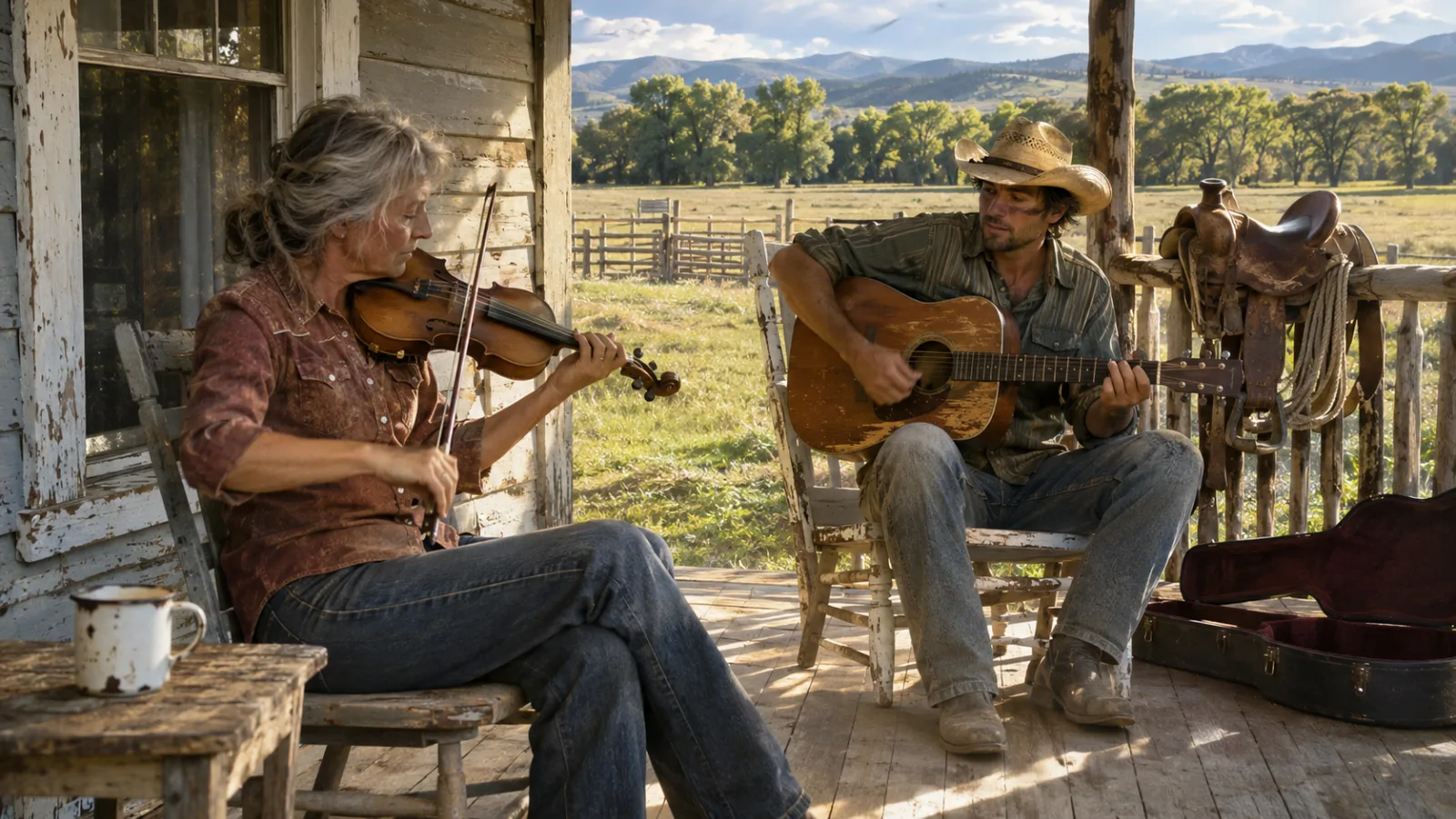
In the 1930s the movies put cowboys on screen with guitars, and professional songwriters began writing new Western songs. These ten are the famous cowboy songs most people can hum.
| Song | Writer | What to know |
|---|---|---|
| "Tumbling Tumbleweeds" | Bob Nolan | The Sons of the Pioneers cut it at their first session, on August 8, 1934. It became their theme. |
| "Cattle Call" | Tex Owens | Written in 1934 around a yodel. Eddy Arnold's 1955 record made it a standard. |
| "Cool Water" | Bob Nolan | Written in 1936 and first recorded in 1941. A man and his mule cross the desert chasing a mirage. |
| "Back in the Saddle Again" | Ray Whitley and Gene Autry | Whitley wrote it for a 1938 film. Autry recorded it in 1939 and made it his radio theme. |
| "Don't Fence Me In" | Cole Porter | Written in 1934 from a poem by Montana highway engineer Robert Fletcher. A number one hit for Bing Crosby and the Andrews Sisters in 1944. |
| "Ghost Riders in the Sky" | Stan Jones | Written in 1948. Vaughn Monroe took it to number one in 1949. |
| "Happy Trails" | Dale Evans | Released in 1952 as the closing theme of The Roy Rogers Show. |
| "High Noon" | Dimitri Tiomkin and Ned Washington | Sung by Tex Ritter in the 1952 film. It won the Academy Award for best song. |
| "El Paso" | Marty Robbins | From his 1959 album Gunfighter Ballads and Trail Songs. A number one pop and country hit and a Grammy winner. |
| "Big Iron" | Marty Robbins | From the same 1959 album. An Arizona ranger faces an outlaw called Texas Red. |
The Sons of the Pioneers deserve their own line. Roy Rogers, Bob Nolan and Tim Spencer formed the group in 1933, and it is still touring. The Library of Congress added their 1934 "Tumbling Tumbleweeds" to the National Recording Registry for the way it captures a cowboy's love of the land.
Stuart Hamblen belongs in this company too. He was one of radio's first singing cowboys, starting in 1926, and recorded his own "Texas Plains" for Decca in 1934. A year later Patsy Montana reworked it into "I Want to Be a Cowboy's Sweetheart," which sold a million copies. Hamblen went on to write "It Is No Secret" and "This Ole House," and he entered the Western Music Hall of Fame in 1999. There is more on him in our piece on what Western music is.
The best cowboy songs, according to Western writers
In 2010 the Western Writers of America asked its members to pick the top 100 Western songs of all time. Their first five:
- "Ghost Riders in the Sky"
- "El Paso"
- "Cool Water"
- "The Streets of Laredo"
- "Back in the Saddle Again"
"Tumbling Tumbleweeds" came in eighth, "Home on the Range" ninth and "Red River Valley" tenth. You can see the whole list here. Only one of the top five is a true trail song, which shows how much the singing cowboys shaped what we now call cowboy music.
Cowboy songs with Colorado roots
Colorado shows up in this music more than people expect.
- "The Colorado Trail" is named for a cattle route that ran northwest into Colorado, not for today's hiking trail. Carl Sandburg printed it in The American Songbag in 1927. The National Park Service has a good short piece on Sandburg and his song collecting.
- "The Streets of Laredo" was claimed, as noted above, by Frank Maynard of Colorado Springs.
- The Flying W Wranglers have sung these songs at the Flying W Ranch chuckwagon suppers in Colorado Springs since 1953.
The tradition is still being added to. Chapter members write new songs about the West every year, and you will find them in our performer directory.
Where to hear cowboy music in Colorado
Recordings are fine, but these songs were made for a room.
- Gatherings. The Western Slope Cowboy Gathering in Grand Junction runs in early November, and the Durango Cowboy Gathering is set for October 6 to 9, 2027.
- Chapter performers. Peggy Malone of Fruita is known for a stick-horse "Ghost Riders in the Sky." Jon Chandler and Patty Clayton both mix the classics with their own songs.
- Radio. Our Western radio page lists shows in Colorado and nearby states that play this music every week.
- The calendar. Confirmed shows and jams are on the chapter events calendar.
The International Western Music Association keeps the wider community together, with charts, awards and a convention each November.
How to start learning the old cowboy songs
You do not need to read music. Most of these use three chords.
- Start with one you already know. "Home on the Range" and "Red River Valley" are the usual first two.
- Learn the story before the tune. If you can tell what happens in "Little Joe, the Wrangler," the verses come easier.
- Sing it slower than the record. Trail songs were sung at a horse's walking pace.
- Add one song a month. In a year you will have a set.
- Bring it to a jam. Nobody at a Western jam minds a beginner.
Most of the traditional songs are in the public domain, so you can sing and record them freely. The singing cowboy songs are still under copyright. When you are ready to meet other players, join the chapter.
Frequently asked questions
What is the most famous cowboy song?
"Home on the Range" is the best known of the old cowboy songs. When the Western Writers of America ranked the top 100 Western songs in 2010, "Ghost Riders in the Sky" finished first.
What are the oldest cowboy songs?
"The Old Chisholm Trail," "The Streets of Laredo" and "Bury Me Not on the Lone Prairie" go back to the trail drives of the 1870s and 1880s. Several use melodies that are older still.
What songs did real cowboys sing?
Working cowboys sang trail songs such as "Git Along, Little Dogies" and "Goodbye Old Paint," along with hymns and popular songs of the day. Slow songs were used on night guard to keep cattle calm.
What is the difference between cowboy songs and country music?
Cowboy songs come from the ranching West and are about the land and the work. Country music grew out of the rural Southeast. The two were sold together for years as "country and western."
Who wrote "Ghost Riders in the Sky"?
Stan Jones wrote "Ghost Riders in the Sky" in 1948. Vaughn Monroe had the number one hit with it in 1949, and it has been recorded many times since.
All posts