The poetry
Cowboy Poetry: What It Is, Famous Poems and Where to Hear It
Cowboy poetry is rhymed verse about ranch life, recited from memory. Its history, famous cowboy poems and poets, and where to hear it in Colorado.
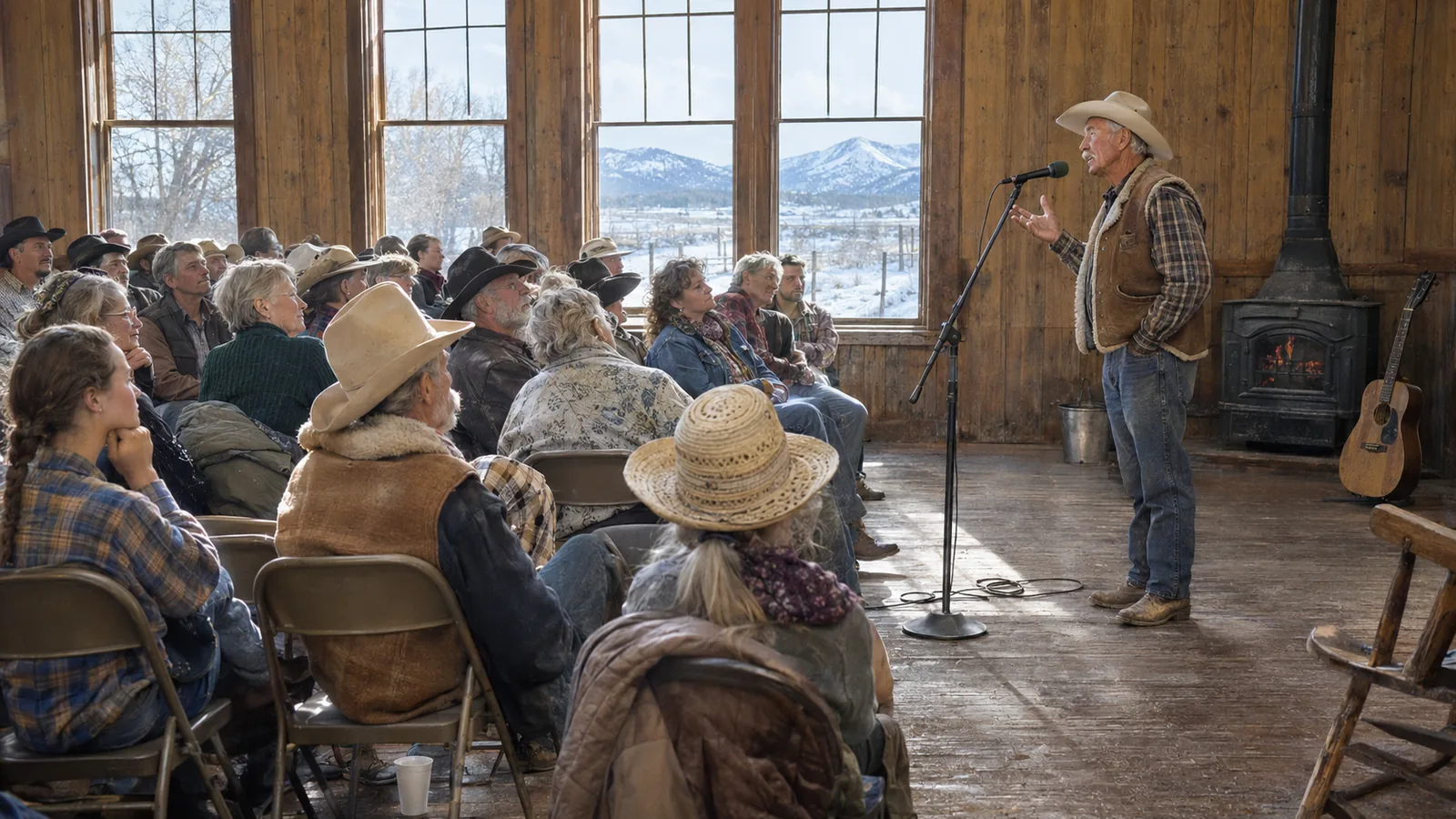
Cowboy poetry is verse written by and about people who work cattle and horses, usually rhymed, usually metered, and usually recited from memory rather than read. It began on the trail drives of the late 1800s, faded from public view, and came back in 1985 when the first Cowboy Poetry Gathering filled a hall in Elko, Nevada.
That is the dictionary version. The real version is a rancher standing at a microphone with no paper in his hand, telling a room full of strangers about a colt that threw him, and getting the biggest laugh of the night on the last line. Here is where it came from, the poems worth knowing, and where to hear it in Colorado.
What is cowboy poetry?
Cowboy poetry is the spoken branch of Western music: the same subjects and the same people, without the guitar. It is about the work, the animals, the weather, the land, and the people who stay with it. Most of it rhymes and keeps a steady beat, and that is not an accident. A poem with strong rhyme and rhythm is easier to memorize, and these poems were made to be carried in the head and said out loud.
Hal Cannon, the folklorist who organized the first Elko gathering and became founding director of the Western Folklife Center, describes the revival as ranch families finally telling their own stories instead of having outsiders tell them. His short essay on Folkstreams is a good two-minute introduction.
For how cowboy verse sits next to cowboy songs, see our piece on what Western music is and how it differs from country.
Where cowboy poetry came from
Cowboys made up verse on the trail long before anyone printed it. Some was sung, some recited, and much of it was never written down. The printed record starts in Texas.
- 1886: Texas cowboy Lysius Gough publishes Western Travels and Other Rhymes in Dallas, the earliest known book of cowboy poetry.
- 1893: Larry Chittenden, author of "The Cowboys' Christmas Ball," publishes Ranch Verses, often called the first major collection.
- 1898: trailing a herd from Chimney Lake, New Mexico, to Higgins, Texas, Jack Thorp writes "Little Joe, the Wrangler."
- 1908: an Estancia, New Mexico, print shop sets Thorp's booklet Songs of the Cowboys, the first published collection of cowboy songs. The expanded 1921 edition is free on the Internet Archive.
- 1910: John Lomax publishes Cowboy Songs and Other Frontier Ballads.
Over the next two decades came the poets still recited at every gathering: Badger Clark, Curley Fletcher, Gail Gardner and Bruce Kiskaddon. Then the singing-cowboy movies took over the public's idea of the West, and the poems lived on mostly among ranch people.
In 1984, folklorists went out across the rural West to record working cowboys who wrote and recited verse. That fieldwork led to a three-day event in Elko from January 31 to February 2, 1985. Cannon recalls that he and buckaroo poet Waddie Mitchell set out about two hundred folding chairs, Mitchell worried it would be embarrassing, and roughly 1,500 people came in the middle of winter. That event grew into the National Cowboy Poetry Gathering, and the 2027 edition will be the 42nd.
Famous cowboy poems every fan should know
Ask ten cowboy poets for the essential list of poems about cowboys and you will get ten lists, but these turn up on most of them.
| Poem | Poet | What to know |
|---|---|---|
| "A Cowboy's Prayer" | Badger Clark | Written in 1906, collected in Sun and Saddle Leather (1915). Recited at rodeos and often printed as "Anonymous." |
| "Little Joe, the Wrangler" | Jack Thorp | Written on a trail drive in 1898, printed in 1908. A night stampede and a young wrangler who did not come back. |
| "The Strawberry Roan" | Curley Fletcher | Written in 1915 about a bronc nobody could ride. Collected in Rhymes of the Roundup (1917) and recorded by many singers in the 1930s. |
| "Tying a Knot in the Devil's Tail" | Gail Gardner | Written in 1917 by a Prescott, Arizona, cowboy. Two cowboys headed home from town rope the Devil. |
| Rhymes of the Ranges | Bruce Kiskaddon | His first collection, 1924. Exact, unromantic poems about everyday ranch work. |
| "Reincarnation" | Wally McRae | A comic poem that opens with a cowpoke asking what reincarnation means. His publisher calls it the most recited poem in contemporary cowboy poetry. |
The first five are old enough to be in the public domain, which is why they appear in so many anthologies of Western poetry. "Reincarnation" is not; Montana Public Radio's write-up links to a video of McRae reciting it at the 2009 gathering.
Cowboy poetry examples: "A Cowboy's Prayer"
If you learn one cowboy poem, make it this one. Badger Clark wrote it in 1906 while he was cowboying in Arizona, and it opens like this:
Oh Lord, I've never lived where churches grow.
I love creation better as it stood
That day You finished it so long ago
And looked upon Your work and called it good.
Notice what makes it work. Every line has ten syllables and the same steady beat. The rhymes fall on every other line, so the ear knows when the next one is due. The words are plain; a ranch kid would not need to look any of them up. And it says something true: a man who works outdoors finds God in the land more easily than in a building.
Clark became South Dakota's first poet laureate in 1937 and liked to call himself the "Poet Lariat." The National Cowboy & Western Heritage Museum has a good short account of his life. His best poem traveled so far without his name that he collected more than fifty printed versions credited to "Anonymous."
Cowboy poets, then and now
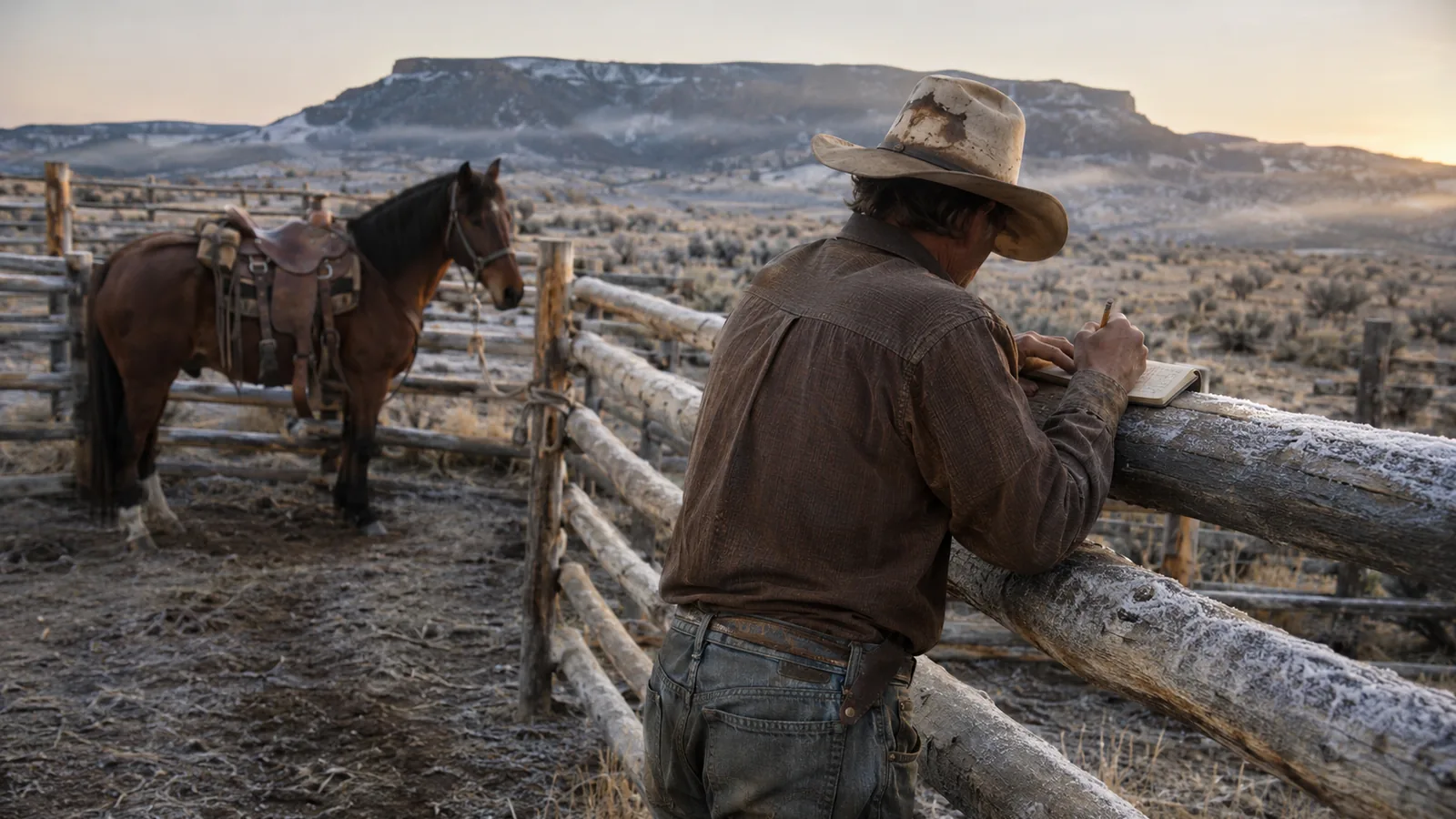
The classic cowboy poets mostly learned the work first and the writing second.
Bruce Kiskaddon (1878 to 1950) is the one Colorado should claim. Born in Pennsylvania, he started cowboying in 1898 in the Picket Wire country of southeastern Colorado, along the Purgatoire River, and worked cattle for about ten years. He served with the cavalry in France in World War I and later worked as a bellhop in Los Angeles, while his poems ran in calendars and books. When the 1985 gathering brought cowboy poetry back, his work was a favorite source for reciters, and Hal Cannon did much to put the spotlight back on him.
Wally McRae ranched on Rosebud Creek in Montana and in 1990 became the first cowboy poet named a National Heritage Fellow by the National Endowment for the Arts. He died in June 2025 at 89.
Colorado's cowboy poets today include working ranchers and plenty of people who came to it later in life. Terry Nash of Loma was the IWMA's Male Poet of the Year in 2018, and his A Good Ride won Cowboy Poetry CD of the Year the same year. KC LaCourse, who grew up in Larkspur, was named the IWMA's 2026 Female Poet of the Year at the convention in Albuquerque this month; she also created Hearts of the West, an online video showcase. The International Western Music Association gives four annual awards for the spoken word: Male Poet, Female Poet, Cowboy Poetry Album and Cowboy Poetry Book of the Year (full list of categories). Colorado poets who perform and take bookings are in our performer directory.
How cowboy poetry is performed
A cowboy poem is a performance, not a reading. What you will usually see at a gathering:
- It is said from memory. That is the tradition and the thing audiences respect most.
- Classics are credited. A poet reciting a Kiskaddon or a Clark says whose it is first.
- Humor and grief sit side by side. A set might open with a wreck story and close with a poem about a good horse.
- It is kept short. At our chapter jams, a recitation counts as one turn and stays under five minutes.
- It is local. The best poems name the creek, the outfit and the year.
Cowboy poetry gatherings: where to hear it
The fastest way to understand cowboy poetry is to sit in a room where it is being recited. These are the big ones within reach of Colorado.
| Gathering | Where | Next dates |
|---|---|---|
| National Cowboy Poetry Gathering (42nd) | Elko, Nevada | January 25 to 30, 2027 |
| Colorado Cowboy Gathering | Golden, Colorado | January; 2027 dates not yet announced |
| Durango Cowboy Gathering | Durango, Colorado | October 6 to 9, 2027 |
| Western Slope Cowboy Gathering | Grand Junction, Colorado | Early November (2026: November 6 and 7) |
Elko is the national gathering, produced by the Western Folklife Center each January, with headline shows, open-mic sessions and workshops. Golden's Colorado Cowboy Gathering brings cowboy poets, Western singers and yodelers to the Front Range; the 2026 edition was at the Buffalo Rose Event Center. The Durango Cowboy Gathering brings in more than 20 poets and musicians from around the country, including a Cowboy Poetry and Music Train. The Western Slope Cowboy Gathering in Grand Junction was started in 2015 by Terry Nash, Peggy Malone and Nona Kelley Carver, and its daytime sessions are free.
Dates change, so check each gathering's site before you book a room. We keep the ones we can confirm on the chapter events calendar.
How to write your own cowboy poem
Most cowboy poets started by trying to get one true story into rhyme. To try it:
- Pick one real moment. Not "ranch life," but the morning the heifer calved in the snow.
- Choose a beat and keep it. Count the syllables in Clark's lines above and copy the pattern.
- Rhyme every other line to start. It is the easiest scheme to hear and to remember.
- Use the words you would use at the sale barn. If you would not say it out loud, cut it.
- Save the turn for the last line, funny or sad.
- Say it out loud a dozen times before anyone hears it.
Then bring it to a jam or an open mic. Young poets can get a mentor through our Youth program, and if you are ready to make it official, join the chapter.
Frequently asked questions
What is cowboy poetry?
Cowboy poetry is verse about ranch and cowboy life, written by people who live it or know it well. Most of it rhymes and has a steady beat, and it is traditionally recited from memory.
What is the most famous cowboy poem?
"A Cowboy's Prayer" by Badger Clark, written in 1906, is widely called the best-known poem in Western circles. It is recited at rodeos and often printed as "Anonymous." Among modern poems, Wally McRae's "Reincarnation" is a favorite.
Who are the most important cowboy poets?
Two classic names to know are Badger Clark, South Dakota's first poet laureate, and Bruce Kiskaddon, who learned ranch work in southeastern Colorado starting in 1898.
When is the National Cowboy Poetry Gathering?
The 42nd National Cowboy Poetry Gathering runs January 25 to 30, 2027, in Elko, Nevada. It is produced by the Western Folklife Center; the first gathering was in 1985.
Where can I hear cowboy poetry in Colorado?
The Colorado Cowboy Gathering in Golden (January), the Durango Cowboy Gathering (October 6 to 9, 2027) and the Western Slope Cowboy Gathering in Grand Junction (early November) all feature cowboy poets. The chapter calendar lists confirmed events.
All posts